Communalism (spelled with a capital C to differentiate it from other forms) is a libertarian socialist political philosophy developed by author and activist Murray Bookchin as a political system to complement his environmental philosophy of social ecology. Communalism proposes that markets be abolished and that land and enterprises – such as private property – be placed increasingly in the custody of the community – more precisely, the custody of citizens in free assemblies and their delegates in confederal councils. (However, Communalism makes allowances for personal property.) The planning of work, the choice of technologies, the management and distribution of goods are seen as questions that can only be resolved in practice. The maxim “from each according to his ability, to each according to his need” is taken as a bedrock guide for an economically rational society, where all goods are designed and manufactured to have the highest durability and quality, a society where needs are guided by rational and ecological standards, and where the ancient notions of limit and balance replace the capitalist imperative of “grow or die”.
In such a municipal economy – confederal, interdependent, and rational by ecological, not only technological, standards – Communalists hold that the special interests that divide people today into workers, professionals, managers, capitalist owners and so on would be melded into a general interest (a social interest) in which people see themselves as citizens guided strictly by the needs of their community and region rather than by personal proclivities and vocational concerns. Here, it is hoped, citizenship would come into its own, and rational as well as ecological interpretations of the public good would supplant class and hierarchical interests.
It’s just before 7 p.m. Monday night, and a line of women is forming outside of City Winery in New York City. An older woman with graying hair flying loosely and with “Resistance” scrawled across her shirt, a young black woman with feminist pins scattered across her denim jacket and a middle-aged Asian woman who appears to have just left the office — all three are part of the growing crowd. They are waiting to enter an event to commemorate the six-month anniversary of the Women’s March on Washington and to kick off the first of many nights organizers are calling the “Resistance Revival.” Read more (7/25/17)
I feel like this would be a slippery slope towards making it illegal for people to choose to not vote.
that’s already how it is in australia
That’s just so fucked up. 😦 Do certain medical conditions exempt you?
?????? why is it be fucked up to have compulsory voting? that’s the way it is in most democratic countries? it’s a part of being a citizen, like paying taxes and obeying speed limits? the fine for not voting is only like $50 and because of the compulsory voting law, our country bends over backwards to make it accessible: it’s always on a weekend, lasts most of the day, and is set up at schools and community centers so there’s one within easy reach of almost everybody. you can also mail your ballot or vote early if you’ll be out of the country on the day. like, IT’S EASY TO VOTE, and the penalty isn’t even that ridiculous. i don’t understand why the usa doesn’t have this, except obviously it would make it harder to literally stop minorities from voting.
I think we Americans tend to forget that a lot of other countries don’t actively work to make it harder to vote.
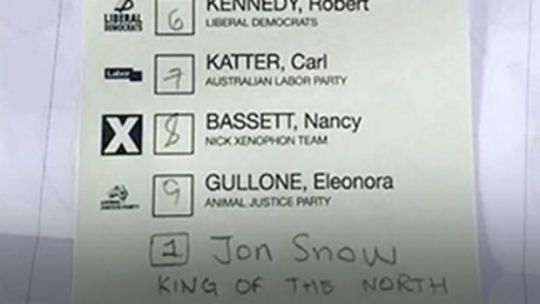
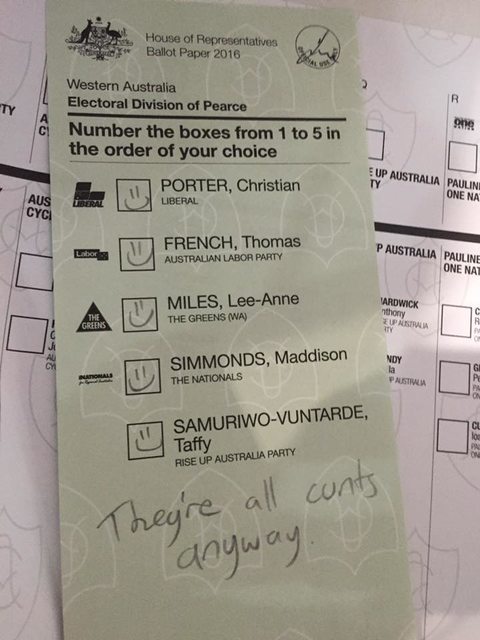
Adding to this here, in Australia you don’t have to vote. Or, more precisely, there’s no way they can tell if you ruined your ballot. You have to turn up, get your name marked off, but you can put a line through the ballot if you don’t think any of the candidates are worth voting for. Or do this:
Or this:
Or this:
You have get your name crossed off (if you don’t want to wear the fine), but you don’t have to make your vote counted if you’re opposed to it.
And it is so, so easy to vote. Stuck at work or on holidays? That’s fine. Do a postal vote. Stuck in hospital? That’s fine. They’ll go to you. Stuck in an old people’s home and can’t get around? Again, they’ll go to you. It’s amazing to me that it’s so hard for so many Americans to actually vote. If you make it compulsory, than at least the government is obligated to provide you with the means to vote.
And look, I get it. Sometimes I don’t want to vote either. But I suck it up, I walk three minutes down the street, and I hope that this year they’re selling lamingtons again. Oh, and I buy a democracy sausage, which, even if all the candidates suck, makes the effort of turning up pretty worthwhile.
ALSO, you can see even on the fucked up ballots that you NUMBER CANDIDATES IN ORDER OF PREFERENCE. There’s no need to calculate whether I would be throwing away my vote on the candidate that I most agree with if they’re not from a major party. I can say, I want that independent person to get in, but if not them, give me Big Party A, and if not them, that minor party person is still better that Big Party B, and I’m not giving any preference to the Lunatic Fringe Party.
Our system certainly has some issues still, but I can show up to somewhere nearby, line up for a few minutes (if at all), vote exactly in line with my values (on paper, leaving a paper trail that can be recounted), and then buy a sausage and some home made cupcakes on my way out.
A country’s voting system matters a hell of a lot and every citizen deserves one that makes it easy to vote and results in a government that is representational and accountable.
And by the way, one time I had a bad asthma flare-up on Election Day and didn’t make it to my polling station. I got my fine in the mail, I filled out the form explaining why I couldn’t vote, no more fine. I would rather have, you know, expressed my preference for who should run my country, but they were cool with the fact that I couldn’t do it that day.
“oh no, what if people actually have to participate in picking the government officials who will impact their lives” jesus christ
“I shouldn’t have to pay for other people’s healthcare” yeah, no, you should. We’re all soft, weak, hairless apes long removed from any species that could survive alone, and you’re alive because of the daily efforts a vast web of people just as weak and helpless as you. That’s what a society is. America requires you to pay extraordinarily little to the common good, but keeping your fellow witless apes alive is part of the small fee. Deal with it or try your luck in the wilderness.
Despite President Donald Trump’s unpopularity — his approval rating is historically low — a new Washington Post-ABC News poll found that only 37% of Americans believe that the Democratic Party “stands for something,” while 52% say that it “just stands against Trump.” And, while more young people voted for Bernie Sanders than cast ballots for Hillary Clinton and Trump combined during the 2016 primaries, registered voters (and particularly young voters of color) stayed home by wide enough margins in November to have likely cost Clinton the election.
So, on Monday, the party will roll out its new campaign platform and slogan, titled “A Better Deal: Better Skills, Better Jobs, Better Wages.”
Already the subject of deep derision by liberals and conservatives alike, the slogan is reportedly the result of several months of focus-group testing by Senate Minority Leader Chuck Schumer and House Minority Leader Nancy Pelosi, representing an attempt on behalf of party leadership to move away from so-called identity politics and put forward a unified economic message in the Trump era.
But advertising and marketing executives panned the effort to Mic in interviews, calling the sloganeering “painfully dry,” “a missed opportunity” and “exactly how the Republican party wins.” All of the executives suggested that the party has, more than six months after the painful loss of Clinton’s presidential race, not learned the lessons of a campaign that failed to connect with enough voters in key states.
“Pretty poor writing”
“There’s just no soul there,” said Joey Ellis, a partner at GrandArmy, which represents Beyoncé, Kanye West, UNIQLO and Tuft & Needle. His co-partner Eric Collins added, “With ‘Make America Great Again,’ you have this four-word slogan where every word counts. With ‘Hope and Change,’ that was also super-clear. But ‘Better Skills, Better Jobs, Better Wages’?”
“I don’t know who’s doing this kind of stuff over there, but this is just pretty poor writing on its face.”
Charlie Jones, president and founder of the Brand Intersection Group, which has worked with SoulCycle, Sweetgreen and Mic, said that the party is failing to articulate what it means to be a Democrat.
Matt Gurney, a former National Post columnist now with GlobalNews and an upper-end millennial (in terms of both age and, apparently, wealth), would like other millennials living in Toronto to know that housing here is expensive. He’d also like you to know that that’s okay, to him. In a column last week, he explains that he’s sorry he owns a wildly expensive house constantly appreciating in value, and he acknowledges that he’s benefited from “a well-timed inheritance or two,” but at great risk of being a jerk, he stands firm: if you can’t stand the housing bubble heat, get out of the city.
I have two issues with Gurney’s column. First, it describes a problem with which anyone in Gurney’s ostensible target audience—non-rich millennials—is well aware. “The sky is blue” is an utterly banal observation; likewise, so is “there is a lot of inequality today.” Even within this inane exercise, Gurney examines only a narrow aspect of the inequality facing Canadians today: young people’s inability to afford a detached home is certainly a problem, but it bleeds into the larger real estate market, which bleeds into the rental market, and all of that is compounded by increasingly deep income and wealth inequality. The exorbitant and rising price of a detached home is simply not the biggest issue facing many young people, but it is inextricably linked to a whole host of pressing concerns.
Second, Gurney offers no genuine solution, even to the specific, small portion of the problem that he identifies. He imagines the situation in which would-be homeowners are unable to secure the housing they’d prefer without having access to significant wealth is irremediable. Just as it was a part of growing up for him to realize that he would never work as a ghostbuster, so it is a part of growing up for Toronto-residing millennials to accept that their equally outlandish dreams of homeownership will ever be realized.
“Short of a major economic shock, housing prices in the heart of the nation’s largest metropolitan area, an emerging global economic and technology hub, aren’t likely to revert,” he writes. This is the thinking of someone who is either ideologically opposed to government intervention or convinced it would be impossible to bring about (readers might be interested to know the author’s view on the matter).
This is such a perfect piece of propaganda for so many reasons. No one besides the most indoctrinated neoliberal would read that and not do a double-take. I smash the reblog button when I see this, every time without hesitation, but really we should be duplicating this and spreading it in our communities.
You’ve probably heard the news that the celebrated post-WW II beating heart of America known as the middle class has gone from “burdened,” to “squeezed” to “dying.” But you might have heard less about what exactly is emerging in its place.
In a new book, The Vanishing Middle Class: Prejudice and Power in a Dual Economy, Peter Temin, Professor Emeritus of Economics at MIT, draws a portrait of the new reality in a way that is frighteningly, indelibly clear: America is not one country anymore. It is becoming two, each with vastly different resources, expectations, and fates.
Two roads diverged
In one of these countries live members of what Temin calls the “FTE sector” (named for finance, technology, and electronics, the industries which largely support its growth). These are the 20 percent of Americans who enjoy college educations, have good jobs, and sleep soundly knowing that they have not only enough money to meet life’s challenges, but also social networks to bolster their success. They grow up with parents who read books to them, tutors to help with homework, and plenty of stimulating things to do and places to go. They travel in planes and drive new cars. The citizens of this country see economic growth all around them and exciting possibilities for the future. They make plans, influence policies, and count themselves as lucky to be Americans.
The FTE citizens rarely visit the country where the other 80 percent of Americans live: the low-wage sector. Here, the world of possibility is shrinking, often dramatically. People are burdened with debt and anxious about their insecure jobs if they have a job at all. Many of them are getting sicker and dying younger than they used to. They get around by crumbling public transport and cars they have trouble paying for. Family life is uncertain here; people often don’t partner for the long-term even when they have children. If they go to college, they finance it by going heavily into debt. They are not thinking about the future; they are focused on surviving the present. The world in which they reside is very different from the one they were taught to believe in. While members of the first country act, these people are acted upon.
The two sectors, notes Temin, have entirely distinct financial systems, residential situations, and educational opportunities. Quite different things happen when they get sick, or when they interact with the law. They move independently of each other. Only one path exists by which the citizens of the low-wage country can enter the affluent one, and that path is fraught with obstacles. Most have no way out.
The richest large economy in the world, says Temin, is coming to have an economic and political structure more like a developing nation. We have entered a phase of regression ,and one of the easiest ways to see it is in our infrastructure: our roads and bridges look more like those in Thailand or Venezuela than the Netherlands or Japan. But it goes far deeper than that, which is why Temin uses a famous economic model created to understand developing nations to describe how far inequality has progressed in the United States. The model is the work of West Indian economist W. Arthur Lewis, the only person of African descent to win a Nobel Prize in economics. For the first time, this model is applied with systematic precision to the U.S.
The result is profoundly disturbing.
In the Lewis model of a dual economy, much of the low-wage sector has little influence over public policy. Check. The high-income sector will keep wages down in the other sector to provide cheap labor for its businesses. Check. Social control is used to keep the low-wage sector from challenging the policies favored by the high-income sector. Mass incarceration – check. The primary goal of the richest members of the high-income sector is to lower taxes. Check. Social and economic mobility is low. Check.
In the developing countries Lewis studied, people try to move from the low-wage sector to the affluent sector by transplanting from rural areas to the city to get a job. Occasionally it works; often it doesn’t. Temin says that today in the U.S., the ticket out is education, which is difficult for two reasons: you have to spend money over a long period of time, and the FTE sector is making those expenditures more and more costly by defunding public schools and making policies that increase student debt burdens.
Getting a good education, Temin observes, isn’t just about a college degree. It has to begin in early childhood, and you need parents who can afford to spend time and resources all along the long journey. If you aspire to college and your family can’t make transfers of money to you on the way, well, good luck to you. Even with a diploma, you will likely find that high-paying jobs come from networks of peers and relatives. Social capital, as well as economic capital, is critical, but because of America’s long history of racism and the obstacles it has created for accumulating both kinds of capital, black graduates often can only find jobs in education, social work, and government instead of higher-paying professional jobs like technology or finance— something most white people are not really aware of. Women are also held back by a long history of sexism and the burdens — made increasingly heavy — of making greater contributions to the unpaid care economy and lack of access to crucial healthcare.
How did we get this way?
What happened to America’s middle class, which rose triumphantly in the post-World War II years, buoyed by the GI bill, the victories of labor unions, and programs that gave the great mass of workers and their families health and pension benefits that provided security?
The dual economy didn’t happen overnight, says Temin. The story started just a couple of years after the ’67 Summer of Love. Around 1970, the productivity of workers began to get divided from their wages. Corporate attorney and later Supreme Court Justice Lewis Powell galvanized the business community to lobby vigorously for its interests. Johnson’s War on Poverty was replaced by Nixon’s War on Drugs, which sectioned off many members of the low-wage sector, disproportionately black, into prisons. Politicians increasingly influenced by the FTE sector turned from public-spirited universalism to free-market individualism. As money-driven politics accelerated (a phenomenon explained by the Investment Theory of Politics, as Temin explains), leaders of the FTE sector became increasingly emboldened to ignore the needs of members of the low-wage sector, or even to actively work against them.
America’s underlying racism has a continuing distorting impact. A majority of the low-wage sector is white, with blacks and Latinos making up the other part, but politicians learned to talk as if the low-wage sector is mostly black because it allowed them to appeal to racial prejudice, which is useful in maintaining support for the structure of the dual economy — and hurting everyone in the low-wage sector. Temin notes that “the desire to preserve the inferior status of blacks has motivated policies against all members of the low-wage sector.”
Temin points out that the presidential race of 2016 both revealed and amplified the anger of the low-wage sector at this increasing imbalance. Low-wage whites who had been largely invisible in public policy until recently came out of their quiet despair to be heard. Unfortunately, present trends are not only continuing, but also accelerating their problems, freezing the dual economy into place.




 lovingdread