M2 9: Wings of a Butterfly Nebula : Are stars better appreciated for their art after they die? Actually, stars usually create their most artistic displays as they die. In the case of low-mass stars like our Sun and M2-9 pictured above, the stars transform themselves from normal stars to white dwarfs by casting off their outer gaseous envelopes. The expended gas frequently forms an impressive display called a planetary nebula that fades gradually over thousands of years. M2-9, a butterfly planetary nebula 2100 light-years away shown in representative colors, has wings that tell a strange but incomplete tale. In the center, two stars orbit inside a gaseous disk 10 times the orbit of Pluto. The expelled envelope of the dying star breaks out from the disk creating the bipolar appearance. Much remains unknown about the physical processes that cause planetary nebulae. via NASA
50 species of lizard and one species of snake reproduce through parthenogenesis (that’s the fancy word for producing offspring as a female without having sex).
Except.
Whiptails are stimulation ovulators. That is to say, they can’t ovulate without having sex.
So not only do they are give birth through immaculate conception, they’re ALL LESBIANS.
There are two kinds of parthenogenesis seen in reptiles. That used by whiptails and the other all female species is true cloning – the egg contains the female’s full genetic material).
Other species including komodo dragons use another form of parthenogenesis where they actually fertilize themselves, with a haploid polar body used instead of a sperm. Because of the way reptile sex chromosomes work, this form of parthenogenesis can produce males as well as females – however, the females produced have weird sex chromosomes and can only lay other females. It’s used as a backup reproductive strategy if they can’t find a mate. This works because in reptiles, unlike mammals, its the males that have two sex chromosomes the same (ZZ) and the females different (ZW). Females produced by parthenogenesis are WW – and that’s what happened to the whiptails. They lost the Z chromosome and now are all WWs.
Mammologists at the Royal Ontario Museum in Toronto have unveiled a preserved blue whale heart.
Weighing in at 600 pounds, roughly the size of a small pony, the heart went on display on Thursday (May 18, 2017).
Without the heart’s blood and supporting structures, the organ weighs around 400 pounds.
The extra pounds came from the steel mesh scientists put inside to keep the ventricles and the thinner blood vessels from collapsing.
The team says it’s the first heart of the marine mammal to ever be preserved fully (by plastination) and could help it last for as long as 1,000 years.
In 2014, nine blue whales died in Canada’s Newfoundland when they became trapped in ice.
When these 300,000-pound creatures die, they almost always sink. But in a rare event, two washed up on the shores of Trout River in the province of Newfoundland and Labrador.
Scientists were then able to salvage some of the whale’s organs to conduct never-before-done research.
Blue whales have the largest hearts of all animals. This organ represents the maximum size a heart can be to continue supporting a living creature, according to scientists. It can pump up to 58 gallons of blood per second.
Before it was displayed in Toronto, the heart traveled from Canada to Germany, where technicians worked on preserving it for more than a year as no facility in North America was big enough to handle a whale heart.
In order to preserve the heart, scientists had to remove all the water from of the tissue, down to the cellular level. They did this by placing the heart in an acetone bath, the same chemical used in nail polish remover.
Next, they had to put it in a synthetic plastic, or polymer, bath. Lastly, scientists put the whole tank of polymer in a vacuum chamber so that the existing acetone would bubble and boil away. The heart remained in this vacuum for more than four months.
The heart was unveiled next to the skeleton of the massive blue whale it came from.
It’s the 1970s, and we’re about to send two spacecraft (Voyager 1 & 2) into space. These two spacecraft will eventually leave our solar system and become the most distant man-made objects…ever. How can we leave our mark on them in the case that other spacefarers find them in the distant future?
The Golden Record.
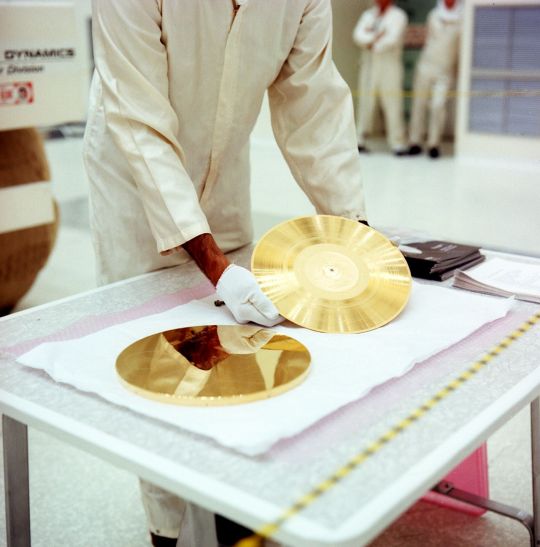
We placed an ambitious message aboard Voyager 1 and 2, a kind of time capsule, intended to communicate a story of our world to extraterrestrials. The Voyager message is carried by a phonograph record, a 12-inch gold-plated copper disk containing sounds and images selected to portray the diversity of life and culture on Earth.
The Golden Record Cover
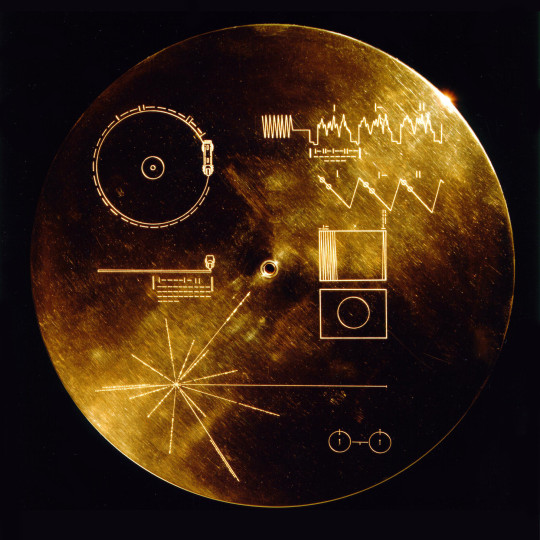
The outward facing cover of the golden record carries instructions in case it is ever found. Detailing to its discoverers how to decipher its meaning.
In the upper left-hand corner is an easily recognized drawing of the phonograph record and the stylus carried with it. The stylus is in the correct position to play the record from the beginning. Written around it in binary arithmetic is the correct time of one rotation of the record. The drawing indicates that the record should be played from the outside in.
The information in the upper right-hand portion of the cover is designed to show how the pictures contained on the record are to be constructed from the recorded signals. The top drawing shows the typical signal that occurs at the start of the picture. The picture is made from this signal, which traces the picture as a series of vertical lines, similar to ordinary television. Immediately below shows how these lines are to be drawn vertically, with staggered “interlace” to give the correct picture rendition. Below that is a drawing of an entire picture raster, showing that there are 52 vertical lines in a complete picture.
Immediately below this is a replica of the first picture on the record to permit the recipients to verify that they are decoding the signals correctly. A circle was used in this picture to ensure that the recipients use the correct ratio of horizontal to vertical height in picture reconstruction.
The drawing in the lower left-hand corner of the cover is the pulsar map previously sent as part of the plaques on Pioneers 10 and 11. It shows the location of the solar system with respect to 14 pulsars, whose precise periods are given.
The drawing containing two circles in the lower right-hand corner is a drawing of the hydrogen atom in its two lowest states, with a connecting line and digit 1 to indicate that the time interval associated with the transition from one state to the other is to be used as the fundamental time scale, both for the time given on the cover and in the decoded pictures.
The Contents
The contents of the record were selected for NASA by a committee chaired by Carl Sagan of Cornell University and his associates.
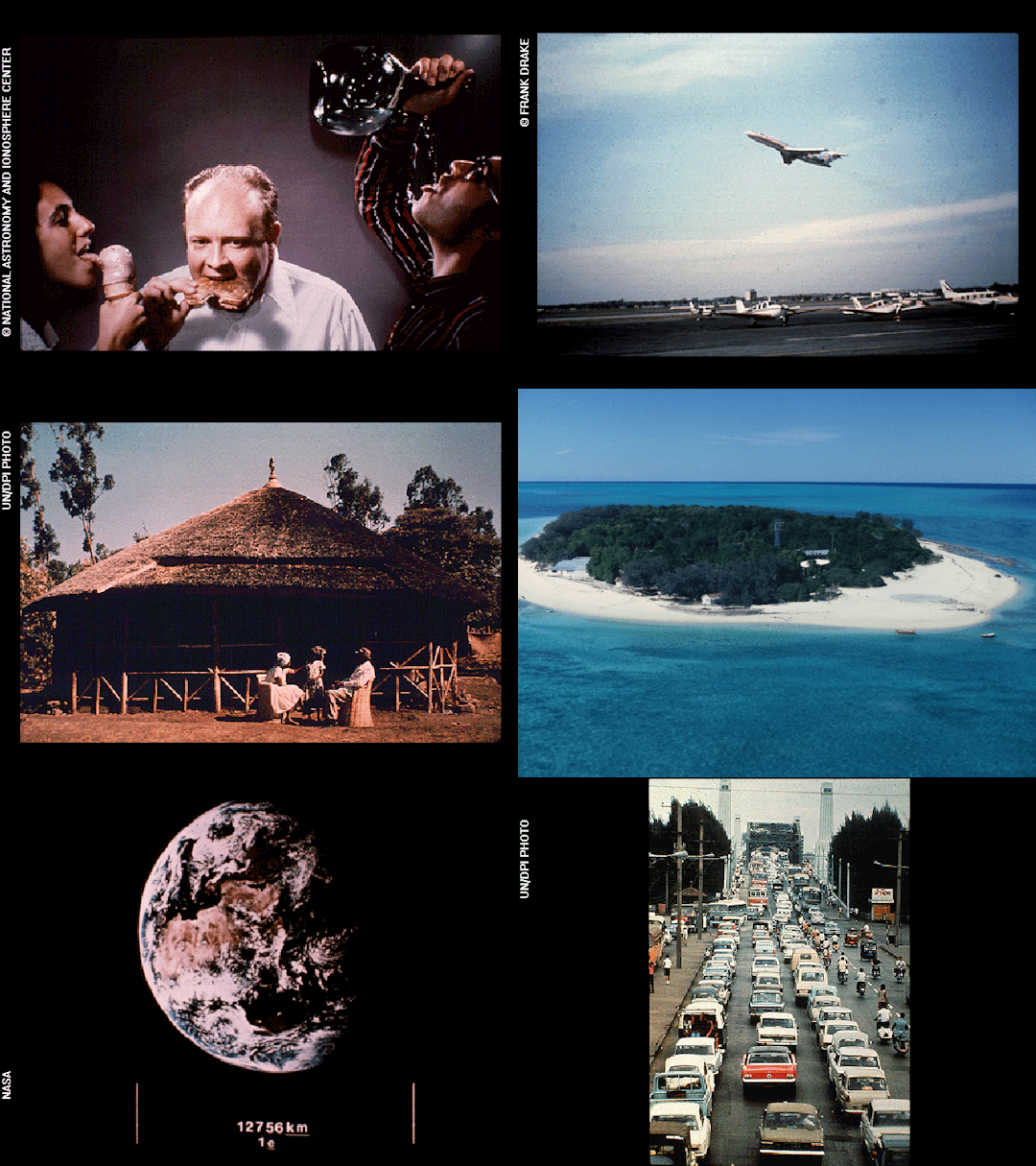
They assembled 115 images and a variety of natural sounds, such as those made by surf, wind and thunder, birds, whales and other animals. To this, they added musical selections from different cultures and eras, and spoken greetings from Earth-people in fifty-five languages, and printed messages from President Carter and U.N. Secretary General Waldheim.
Listen to some of the sounds of the Golden Record on our Soundcloud page:
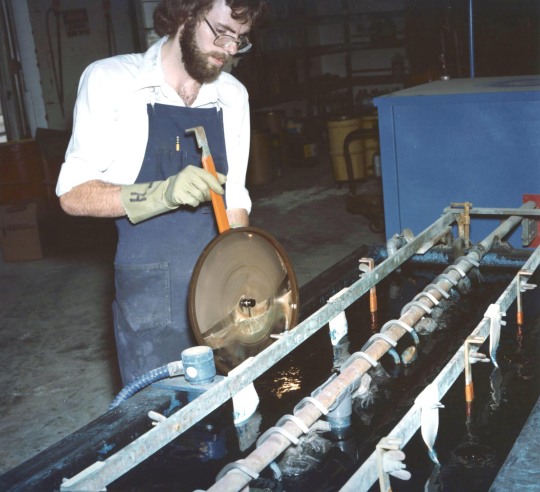
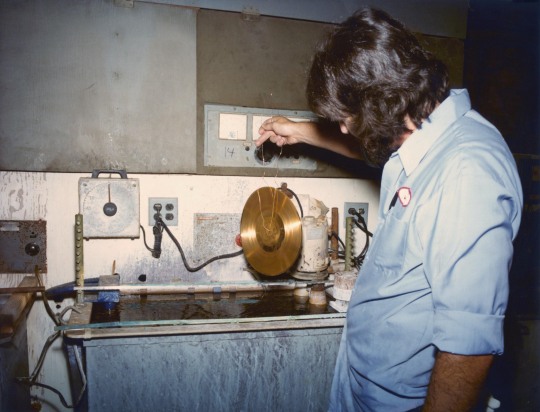
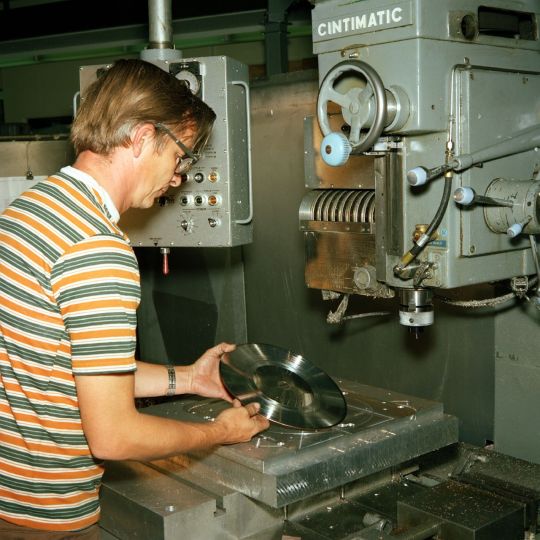
Blank records were provided by the Pyral S.A. of Creteil, France. CBS Records contracted the JVC Cutting Center in Boulder, CO to cut the lacquer masters which were then sent to the James G. Lee Record Processing center in Gardena, CA to cut and gold plate eight Voyager records.
The record is constructed of gold-plated copper and is 12 inches in diameter. The record’s cover is aluminum and electroplated upon it is an ultra-pure sample of the isotope uranium-238. Uranium-238 has a half-life of 4.468 billion years.
Psychiatry professor Matthew Johnson, who works at Johns Hopkins University School of Medicine, presented the preliminary results of a pilot feasibility study looking at the ability of psilocybin to treat smoking addiction at the 2013 Psychedelic Science conference in Oakland, Calif. For the study, five cigarette-addicted participants underwent placebo-controlled psilocybin treatment with a psychiatrist. All five completely quit smoking after their first psilocybin session. (source)
Apparently y’all love plants as much as I do so here are some more facts!
•All of the mass of a tree comes from the air. As plants take in carbon dioxide they convert it into solid structures called cellulose to make their cell walls. Before the 1600s people thought plants grew by eating soil.
• The first animal to be cloned, Dolly the sheep was cloned in 1996 but botanists began cloning plants in the 1950s.
•Pollen is not actually plant sperm!!!! Pollen is the microspore stage of angiosperms. It is actually a fully formed microscopic plant. Seriously, look it up if you don’t believe me.
•Leaves are technically plant organs.
•Juniper berries are not true berries. They are not made like fruits are, because fruits come from angiosperms (flowering plants) and junipers are a type of gymnosperm (conifers and cycads). Juniper berries are really just fleshy cones.
•Plants need soil for a special reason. Unlike just plain old dirt, soil contains something called soil solution which has positively charged ions the the plant needs to grow. This is why areas that are over-farmed become dead zones. All the cations have been absorbed.
•The little dots on the undersides of true ferns are called sori and they produce spores.
•If you cut off the top of a plant it will never grow any taller. You have removed the shoot apical meristem. By removing it you have inhibited the release of a certain hormone that will then cause the plant to grow side to side and become more bushy. This technique is how bush sculpting is possible.
•Any plant that does not produce wood is referred to as an herbaceous plant.
•Carnivorous plants like Venus flytrap and pitcher plants only catch insects for minerals. They still get all of their energy from photosynthesis but they need the bugs for things like nitrogen. This is because they are usually native to areas with low nutrient, acidic soils.
• All plants make spores but only some plants make seeds.
all commercially available bananas are the same banana. they’re clones. the current banana variety, the Cavendish, is seedless, which means it’s sterile. so the only way it can reproduce is by cloning. this might seem weird to some folks, but plants have a much easier time cloning themselves than any given mammal, and some plants actually use it as their main form of reproduction! so while cloned seedless plants may be nice for the banana eater, because you don’t have to worry about those pesky seeds (they’re really not that bad imho), but these plants miss out on a whole lot of the genetic diversity that comes with sexual reproduction. and when you don’t have diversity, your crop is not very resilient. this is a good post explaining monocrops and how bad they can get
there is some good behind monocrops, one being that from a production perspective, you only need one machine or process to take care of you plants, versus 3 machines for 3 different crops on the same land. and as a consumer, you know what you’re gonna get?????? idk man i like me some variety.
if all of your banana plants are functionally identical, this gets you a monocrop. these can be very, very bad. because, if your banana clone is very susceptible to cold temperatures, the majority of a crop can be wiped out with one early morning freeze. if your monocrop doesn’t have a lot of tolerance to fungal disease, then with the right fungus you whole crop’s gonna go extinct. the previous banana variety to this, the Gros Michel, has gone functionally extinct due to a fungus strain. and guess what, similar strains of this fungus also threaten the world’s stock of Cavendish plants. banana breeding is WACK anyways, and its kinda hard because of all the hybridization required to get your Perfect Bananner, but if we were less dependent on literally one banana plant that would be very good thank you
some folks still do grow Gros Michel bananas, though not commercially, and apparently they taste like your familiar Cavendish bananas, but sweeter, more flavorful, and a lot more like banana artificial flavor.
bananas also have a long and storied history of colonialism, and this is where the political term “banana republic” comes from. honduras is a country in central america, and they had just democratically elected a leftist government. good for them! woohoo! a bunch of american businessmen did not like that, so their fruit companies led ACTUAL ARMIES into tegucigalpa (the capital) to put in power their own right-wing dictatorships. these companies razed the land and were absolutely shitty to the people, all so that american consumers could enjoy lower fruit prices. yeah, this was all about lower fruit prices. nice job, capitalism.
also uuuuuh they’re berries too! here’s the inflorescence of one that’s kinda related to production plants!
yeah that’s one Big Boy right there. since they do not have woody stems (cause it needs a woody stem to be a tree), but rather fleshy yet sturdy pseudostems, bananas are technically herbs!
modern bananas are capitalism with some added nutritional value, and they taste like barely sweet spongy chalk. fuck you, bananas.
science side of tumblr why do all of us mentally ill ppl like storms so much
@revelationed said:
Rain/moving water has negative ions which cause a biochemical reaction that reduces stress. It’s the same reason people feel more at peace on beaches or by waterfalls. We spend most of our lives surrounded by positive ions created by electronics and recirculated air. A study by Columbia University showed that negative ions can have the same affect as antidepressants.
Usually, if a sea star gets an infection in an arm, it has a trick up its sleeve: The limb drops off and the sea star builds a new one.
But in 2013, scientists studying the early days of what they later named sea star wasting disease noticed that the new infection progressed too quickly for the critters to regenerate their way to health.It’s a gruesome fate.
The creature shifts from healthy starfish to detached limbs wandering the seafloor and bodies made of mush, and all in less than two days.And the disease isn’t picky about what kind of sea stars it infects; scientists estimate it hit between 15 and 20 species along the Pacific Coast of North America.






 lovingdread