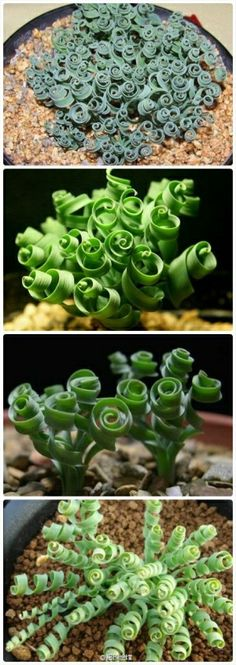
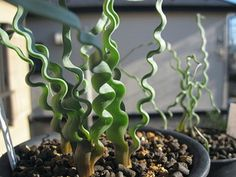
This is a plant from the genus Trachyandra, specifically known as a Crassula succulent. They are mostly found throughout southern Africa and Madagascar.
I am reblogging so I can look into this more closely. Because 1. That looks kind of like polymer clay; and 2. Crassula is a genus of succulent, containing over 1400 species of plant, and I’m on mobile.
I can never tell if succulents I haven’t seen are real or not because all succulents look fake in the first place
Here to tell you HAPPILY cause i love these plants that they are in fact real BUT the actual name of the plant is Trachyandra tortilis! They also come in a flat leaf version with curled or wavy leaves!!
Circus Tree: Six individual sycamore trees were shaped, bent, and braided to form this.
Actually pretty easy. Trees don’t reject tissue from other trees in the same family. You bend the tree to another tree when it is a sapling, scrape off the bark on both trees where they touch, add some damp sphagnum moss around them to keep everything slightly moist and bind them together. Then wait a few years- The trees will have grown together.
You can use a similar technique to graft a lemon branch or a lime branch or even both- onto an orange tree and have one tree that has all three fruits.
Frankentrees.
As a biologist I can clearly state that plants are fucking weird and you should probably be slightly afraid of them.
On that note! At the university (UBC) located in town, the Agriculture students were told by their teacher that a tree flipped upside down would die. So they took an excavator and flipped the tree upside down. And it’s still growing. But the branches are now the roots, and the roots are now these super gnarly looking branches. Be afraid.
But Vi, how can you mention that and NOT post a picture? D:
I am both amazed and horrified of nature as we all should be
I love how trees are like “fuck it, I’ll deal” at literally everything. Forest fire? Cool, my seeds’ll finally grow. Upside down? Branches, suck, roots, leave. What’s this new branch? Eh, welcome to the tree buddy.
I need to be more like tree
I continue to fear and respect out arboreal overlords.
what kind of professor did these students have that they needed to prove him wrong so badly that they literally dug up a tree, flipped it and put it back in the ground?
Sounds like y’all’ve never heard about the Tree of 40 Fruits. Well, it’s exactly as it sounds. Sam Van Aken, an artist based in New York, decided to try his hand at grafting (e.g. the process by which you attach the branches of a different tree to a host tree).
As artists are inclined to do he decided to push some limits and over the course of a few years he grafted over 40 different fruit onto the host “
including almond, apricot, cherry, nectarine, peach and plum varieties.”
It has a fruiting period lasting from July to October and this is what it looks like when blossoming.
Shit’s tight yo.
Also we have a group called the Guerrilla Grafters. A group who started in San Fransisco with the goal of grafting fruiting branches onto non-fruiting trees of the same type.
Most cities have fruit trees that simply don’t produce fruit because having all these would be a mess and inadvertently providing unregulated food to people comes with a lot of legal risks I suppose. These grafters seem to think otherwise and have taken it upon themselves to try and bring fruit trees back to urban areas.
HOLY SHIT
THE LAST ONE
Solarpunk as fuck!!
Reblogging for “I continue to fear and respect out arboreal overlords.”
Giant hogweed (Heracleum mantegazzianum) is an invasive herb in the carrot family which was originally brought to North America from Asia and has since become established in the New England, Mid-Atlantic, and Northwest regions of the United States. Giant hogweed grows along streams and rivers and in fields, forests, yards and roadsides, and a giant hogweed plant can reach 14 feet or more in height with compound leaves up to 5 feet in width.
Giant Hogweed sap contains toxic chemicals known as Furanocoumarins. When these chemicals come into contact with the skin and are exposed to sunlight, they cause a condition called Phytophotodermatitis, a reddening of the skin often followed by severe blistering and burns. These injuries can last for several months, and even after they have subsided the affected areas of skin can remain sensitive to light for years. Furanocoumarins are also carcinogenic and teratogenic, meaning they can cause cancer and birth defects. The sap can also cause temporary (or even permanent) blindness if introduced into the eyes.
If someone comes into physical contact with Giant Hogweed, the following steps should be taken:
Wash the affected area thoroughly with soap and COLD water as soon as possible.
Keep the exposed area away from sunlight for 48 hours.
If Hogweed sap gets into the eyes, rinse them with water and wear sunglasses.
See a doctor if any sign of reaction sets in.
If a reaction occurs, the early application of topical steroids may lessen the severity of the reaction and ease the discomfort. The affected area of skin may remain sensitive to sunlight for a few years, so applying sun block and keeping the affected area shielded from the sun whenever possible are sensible precautions
PLEASE, DO NOT JUST READ AND SCROLL! THIS IS VERY IMPORTANT AND POTENTIALLY LIFE-SAVING INFORMATION!!!
Extra note: if you live in Oregon, New Jersey, Michigan or New York and see one of these, call your state’s department of agriculture to report it, and trained professionals will come kill it before it can produce seeds and spread.
Frankly, if you see one in general, probably call your DOA and see if there’s a program in place.
Do not burn it, because the smoke will give you the same reaction.
If for some ungodly reason there isn’t a professional who can handle it for you (and please, please use a professional), the DOA of New York has [this guide] for how to deal with it yourself.
OH MY FUCK I HAVE THESE IN MY BACKYARD.
Fucking invasives. Signal boost.
Re-reblogging because I checked Snopes, and not only is this shit true, but the text on this is pretty much the same as it is there! Stay safe, kiddos.
According to the US Department of Agriculture, these are currently the states and provinces in North America where Giant Hogweed is present. Even if your state/province is “clear” that doesn’t mean that it is not there. If you see Giant Hogweed in your yard or anywhere please call your DOA! This stuff is mad deadly!
Also here is a human for size reference. Since they are huge it should be easy enough to see and spot when fully grown.
The burns can also be very bad, far worse than any poison ivy. Just Google ‘Giant Hogweed Burns’ and you’ll see. It can cause bad blistering, red painful rashes, and more. Please be careful of this plant!
They exist in Austria and Germany too. Please be careful!
Also, if you are in the Iowa/Minnesota area (maybe farther, I don’t exactly know), there is a close relative (also invasive) with yellow flowers called wild parsnip.
It only gets to about half the size of giant hogweed but has all the same toxic effects. The plants in the pictures look small but I’ve seen ones at least 6 feet tall with stems two inches thick.
A lot of pictures available of giant hogweed are fullsized and in bloom. Just because it lacks the flowers doesn’t mean it’s not hogweed! It is dangerous well before that point.
As seen above, another important detail when identifying them can be the stems. They often have this reddish speckling, and are covered in bristly hairs. Like the rest of the plant, you should absolutely not touch them either.
You can see here how the redness is mostly on larger, older portions of the stems.
For those of you in Ontario, here is a link to some more information via Ontario’s Invading Species Awareness Program . It has details on the plant’s growth, removal methods, and groups you can report sightings to.
Unfortunately I lack information on herbicide use, but if the responsibility of removing giant hogweed somehow falls to the owner, please research local laws/restrictions concerning the use of things such as glyphosate (roundup). It is always possible to make things worse instead of better, so exercise caution in all areas, not just the handling/disposal of the plant.
This is not bullshit. My sister works for the Cooperative Extension in New York and this is a big P.R. focus for them. They have trouble because somebody may spot some of these on a neighbor’s property and call it in, but they can’t get permission to go in and take it out because the neighbors think it’s “pretty” or they “natural” and want it to stay.
Here’s another thing about it that makes it dangerous and maybe might scare some people into doing something about it: this time of year, (winter) the dried stuff is tailor-made for attracting kids: long, light, jointed. It looks like bamboo and they will use it to frame up little huts, make beaded necklaces, use as “sword.”, etc. The worst is it’s hollow which makes it perfect for BLOW GUNS. Imagine getting that stuff on your lips….
I work at an environmental science college and can also confirm this. This stuff is bad bad bad news.
To all you aspiring herbalists and just nature adventurers: please, pelase be careful
Giant Hogweed is very real, just always the note of caution that it resembles a bunch of normal plants, and some of the original scare posts conveniently omit the details like the giant size that are one of the big giveaways. There’s lots of other plants like Queen Anne’s Lace that look the same but are a lot smaller, so keep in mind the “human used for reference” pic above. The link below has full info plus a linked pdf of all the lookalikes.
As an aspiring biologist, especially interested in poisonous plants and the like, DON’T TOUCH THIS PLANT! I often take very small cuttings from common species on hikes to study and classify, but I know which are irritants and which are not. I suggest looking on these websites for a very BASIC knowledge of skin-irritant causing plants. This information is invaluable on hikes, while camping, traveling, gardening, etc. I consider these sources to be useful and very accurate:
The DNR just posted it’s in my state too, and as far as Illinois and Nebraska. Be safe sweeties!
Ick!!
Holy shit this is in MAINE? *shudder*
signal boosting, because this is such a dangerous plant.
*is off to investigate if this has been found in her town*
IF YOU SEE THIS PLANT IN OREGON, PLEASE REPORT IT!
YOU MAY REPORT IT TO:
THE OREGON DEPARTMENT OF AGRICULTURE’S NOXIOUS WEED PROGRAM
503-986-4621 or 1-866-INVADER (( I hope these are updated and accurate!!))
If anyone in Oregon finds it, and is too nervous to call, seriously, if I can I will call for you!! I’m not sure if that’s “allowed”? But I’ll give it a shot, seriously. If you give me all the location and descriptive info I need to report the plant properly, I will call for you. I love nature, and protecting ecosystems is everything to me. Not to mention, (but I’m gonna), plant biology/ conservation/invasive management is my specialty in terms of my degree. ♡♡♡
Topping out around 60 cm (24 inches), Dawsonia superba enjoys
heights normally reserved for vascular plants. Although this may not
seem like much to those who are more familiar with robust forbs and
towering trees, height is not a trait that comes easy to mosses. To find
out why, we must take a look at the interior workings of these lowly
plants.
Mosses as a whole
lack the vascularization of more derived plants. In other words, they do
not have the internal plumbing that can carry water to various tissues.
Coupled with the lack of a cuticle, this means that mosses are quite
sensitive to water loss. For most mosses, this anatomical feature
relegates them to humid environments and/or a small stature. This is not
the case for Dawsonia. Thanks to a curious case of convergent evolution, this genus breaks this physiological glass ceiling and reaches for the sky…
ok so a quick lesson on the weird physiology of this species:
this is Amorphophallus titanum. it’s not the largest flower in the world, but actually the largest unbranched flower structure. this is because this isn’t actually one flower, but hundreds; the actual flowers are super tiny and simple male and female structures nested deep in the “flower” you see here! (x)(x)
closeup of the flowers (male on top, female on bottom):
the fruits will look like this when its all done blooming! (x) (x)
full life cycle from the botany department at the university of Wisconsin Madison (i got to see a couple of their plants in their non-flowering phases when i visited; they have their largest and oldest one named Bucky, and a few younger plants that they grew from his fruits):
Usually, the fruits are given to conservatories and colleges for study and endless admiration, but they’ve become more advanced hobbyists in recent years! All in all, it’s most important for those growing it to help make sure as many of its fruits as possible make it into the ground, so the species will be with us for many years to come.
some more facts:
-on average, the tuber weighs about 110 pounds. the one blooming at CC right now is actually kind of small, at around 40 pounds (it’s kind of a young plant at only 10 years old, and its only her first bloom!)
-the largest tuber is currently being grown by a surgeon in New Hampshire. it’s 305 pounds. this plant also has the record for the largest bloom so far; when it last bloomed in 2010, it was 10 feet, 2 inches tall. for scale, Audrey is a 5 foot, 5 inch bloom. i know ur dying to see the 10 foot tall one so here:
-after the first bloom, its kind of up to the plant as to when it’ll bloom again. some bloom after another 7-10 years, some bloom every 3, and a few individuals pulled back-to-back blooms a few years ago and it was a big deal.
-at this point, the population of this species in captivity has increased so there’s an average of five or so blooms in the entire world each year.
-did i mention that they reek like rotting flesh when they bloom to attract their pollinators, which are flies and beetles? bc they do that btw
-there have been cases of a single tuber sending up a couple blooms at once, and one case so far of a tuber having multiple blooms at once:
-i’ve talked on here about how weird petioles are. well, the vegetative phase of the titan arum actually is one single leaf with many leaflets, like so:
-self-pollination is rare, but it can be done with the proper procedures:
-Audrey is tied for the fourth one to bloom this year, after Java and Sumatra at the Chicago Botanical Gardens in May, Terra at the San Fransisco Conservatory of Flowers earlier this month, and Titus at Cambridge University, who bloomed at the same time as Audrey yesterday! they are all good babies and i am proud of all of them
-also yes most of these plants in captivity have have names and i should make a masterpost of them so you guys know what to name ur first born child after
-i’ve mentioned this on this blog before but i’m doing it again. they heat up to 90 degrees during bloom
tl;dr: these are good big stinky jungle babies and i love them and want to see one bloom in person one day
also, Audrey is on a live stream here if you want to see her!
They’re lovely, but they MUST be kept in a pot, or a raised bed, or on a good-quality leash with a chest harness, because mint and its cousins spread like… IDEK, like a rash. Like dandelions. They’re tough, hardy and highly motivated. Even a tiny root fragment will suddenly turn into a Mint Tree if you don’t tear it up. I swear I’ve seen new plants popping up from BURIED SCRAPS OF LEAF. Once they’re in the ground they establish a beachhead and spawn secretly, possibly through osmosis. I cannot advise you to stick a mint plant in the ground unless you are a bold and unconventional disciplinarian.
The joke is that after running around after the mint like a spaniel chasing a whack-a-mole for a year, Dr Glass then planted a plant that would do the same thing.
Great plants, hard to kill, keep them in a pot (ESPECIALLY where invasive)
I would really recommend against planting mint in raised beds, and also, if in a pot, DO NOT PUT THE POT ON SOIL. The pot needs to be on rock or concrete. Otherwise the roots will head straight for freedom through the drainage holes, and you will Never Be Free.
of course, on the other hand, if you’re at all inclined to pettiness expressed via herbology, mint makes a GREAT vehicle for plant-based vengeance.
i have absolutely thrown mint roots into the perfectly manicured lawns of people i hate.
An ever growing mint plant appearing in my lawn would seem like the opposite of a problem to me?
They’re invasive, which means if they’re anywhere in your garden or manicured areas they could ruin the other plants, I think? But yeah I’d love to have a damn mint plant in my yard sounds ideal.
Has anyone ever thought of just having a lawn of mint instead of grass? Like how you have moss lawns?
… I am not judging!! but I don’t think the people in the notes who are like “oh a mint lawn would be lovely!” have met mint!
You know what would be a lovely herbal lawn? Chamomile. Because it’s a damn compact, densely-growing, hardy, winter-green perennial that’s springy underfoot, smells nice when you walk on it, and has some basic manners. Lawn chamomile is plushy and soft and produces tiny pretty daisy-looking flowers. It naturally stays at pretty much the height you would want grass to be, and then you can cut it and it goes “fair enough.”
Mint is not any of those things. Mint is leggy, patchy, muddy and rampageous. It grows randomly and fitfully. It bullies other plants. It sends runners into the neighbor’s houses and across the street and it barks at the postman. Your mint lawn would look like a poorly tended graveyard AND THEN IN THE WINTER IT WOULD DIE, DRAMATICALLY, and ROT THERE. It would outcompete native plants and eat your vegetable garden alive. It is so wet and stalky that it would be dreadful to trim, and when you trimmed it, it would scab over and sulk. It would refuse to grow where it was put (the lawn) and would instead show up in places you don’t want it (the patio, the sidewalk, your intrusive thoughts.) IT IS AN INVASIVE PLANT, WHY WOULD YOU DO THIS TO YOUR FAMILY
It’s like asking why people don’t make lawns out of cabbages, or hyenas, or the cold virus. BECAUSE THEN IT WOULDN’T BE A LAWN OR A GARDEN
Today on plants doing ridiculous bullshit: some very misguided gardener slapped these two halves of cherry tree together, and they said “fuck it we’ll make do” then became a successful tree






 lovingdread