The water opossum (Chironectes minimus), also locally known as the yapok, is a marsupial of the family Didelphidae. It is the only living member of its genus, Chironectes. This semiaquatic creature is found in and near the freshwater streams and lakes in Mexico, Central and South America to Argentina, and is the most aquatic living marsupial. It is also the only living marsupial in which both sexes have a pouch.
unquestionably sea horses are one of the most bizarre looking sea creatures. Pipefish, a close cousin is even weirder. Look at these fishes and you will agree with me.
Along with sea horses and sea dragons, the pipefish belong to the group
Syngnathidae. There are thousands of species living in the oceans.
Like their sea horse brethren, the male pipefishes also do parenting duties like carrying eggs and also “giving birth”.
Most of the pipefish species live in the coral reefs. Some can also be spotted in sea grass beds. Here are some more photos of them.
50 species of lizard and one species of snake reproduce through parthenogenesis (that’s the fancy word for producing offspring as a female without having sex).
Except.
Whiptails are stimulation ovulators. That is to say, they can’t ovulate without having sex.
So not only do they are give birth through immaculate conception, they’re ALL LESBIANS.
There are two kinds of parthenogenesis seen in reptiles. That used by whiptails and the other all female species is true cloning – the egg contains the female’s full genetic material).
Other species including komodo dragons use another form of parthenogenesis where they actually fertilize themselves, with a haploid polar body used instead of a sperm. Because of the way reptile sex chromosomes work, this form of parthenogenesis can produce males as well as females – however, the females produced have weird sex chromosomes and can only lay other females. It’s used as a backup reproductive strategy if they can’t find a mate. This works because in reptiles, unlike mammals, its the males that have two sex chromosomes the same (ZZ) and the females different (ZW). Females produced by parthenogenesis are WW – and that’s what happened to the whiptails. They lost the Z chromosome and now are all WWs.
This is true! The zoo where I volunteer (the illustrious Columbus Zoo & Aquarium) was one of the pioneers of this program.
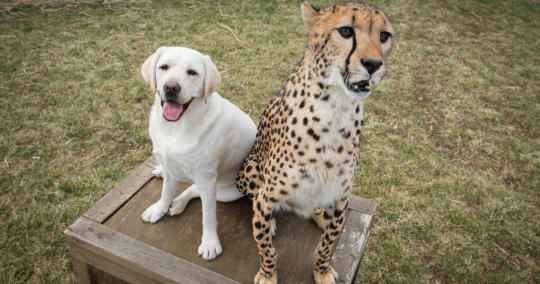
Our zoo is known for raising cheetah cubs. Cheetahs have a terrible infant mortality rate and cubs are often rejected, so we get a lot of cubs to raise from all over the country (other zoos and sanctuaries, mostly).
The cubs are placed with a puppy friend when they are wee and small, so they grow up together like littermates. They play together, wrestle, and the dogs (yellow Labs) are so calm, friendly and well-socialized that the cheetahs take behavioral cues from them. When they meet new people, or go into new situations (which they often do, as ambassador animals for cheetah conservation), they check out if their dog friend is feeling chill – which he is – and then they know it’s okay for them to be chill, too.
Basically the dog is a service animal for them.
The cats need their dog friends less and less as they get older and more comfortable, but they still often hang out as grownups.
Our zoo does cheetah runs, where the cheetahs get to chase a lure and show off their speed. Often they’ll have one of the cheetahs run (we have like twelve cheetah), and then they’ll have one of the dogs do the run to show how much faster the cats are. People get a kick out of that. The dogs…let’s just say they try their best.
San Diego Zoo has this too! They take the Cheetahs and doggies out for walks around the zoo and they are very sweet….
Who’s this? Meet Mosi, a floppy-eared okapi calf born at the San Diego Zoo. What’s an okapi?It’s not a zebra, antelope or any other species. It’s just an okapi, the only living relative of the giraffe and an endangered species. Learn more about Mosi here.
1. There are several ways to classify the large cats, one of the more useful ones is into the roaring cats (tigers, lions) and the purring cats (bobcats, lynxes). The puma (also known as the mountain lion) is the largest cat that purrs. I’ve heard it up close, it’s amazing. A cheetah’s purr sounds like an idling motorcycle engine.
2. Kangaroos cannot move their legs independently of each other, they have to move them in sync – when they’re on land. When they’re swimming, they can move them separately. Hopping is their most efficient way to move – a walking kangaroo is awkward as hell. They swing both legs forward using their tail as a third leg to prop up while their legs swing.
3. People often think that flamingoes’ knees bend the wrong way. They don’t – the joint you’re seeing in the middle of their leg isn’t their knee, it’s their ankle. Their knee is up by their body, and it bends the same way ours does.
4. Giraffes only sleep 1-2 hours a day.
5. Bald eagles’ vocalizations are not what you expect. When you see a flying bald eagle in the movies and hear that majestic caw sound? That isn’t an eagle, it’s been dubbed over with another bird, usually a red-tailed hawk. Bald eagles actually sound…not majestic. Kind of like if a kitten could be a bird.
6. Elephants are one of only a handful of animals that can pass the mirror test – in other words, they can recognize their own reflection (and not think it’s another animal, as dogs and cats usually do). They tested this by placing a chalk mark on an elephant’s forehead and then showing it a mirror. The elephant investigated the mark on its own forehead, indicating it knew that it was looking at itself. The only animals that pass this test are the higher primates, the higher cetaceans (orcas, dolphines), elephants, and weirdly, magpies.
7. One-fifth of all the known mammal species are bats.
8. A kangaroo mother can have three joeys simultaneously at different stages of development: an embryo in her womb (kangaroos can do what’s called embryonic diapause which means sort of putting the development on pause until she’s ready for it to develop further), a joey in her pouch attached to one nipple, and a joey out of the pouch on the ground who nurses from the other one. The amazing thing? Each of her nipples make different formulations of milk for each joey’s different nutritional needs.
9. Bonobos, our closest genetic relative (they are more closely related to us than they are to either chimps or gorillas) are almost entirely non-aggressive, matriarchal, and use sex to solve all their problems. They engage in both same and opposite sex interactions, non-penetrative sex (oral, rubbing, manual) and with any age. That’s an interesting area to work in, lemme tell you.
10. Tortoises have super loud sex. Like, really loud.
11. All grizzlies are brown bears, but not all brown bears are grizzlies (grizzlies are a sub-categorization of the brown bear).
12. Reindeer are the only deer species where both males and females grow antlers. The males shed theirs the beginning of December, the females shed theirs in the spring. So all of Santa’s reindeer are girls, heh. I love telling little kids that.
13. If a rhinoceros knocks off its horn, it grows back faster than you’d expect. One of ours, Rosie, has knocked hers off twice.
14. Gorillas get crushes on each other. And on the humans that take care of them. Male gorillas also masturbate. I don’t know if the females do, I’ve never seen it. Sometimes it’s like a soap opera up in there.
15. Langur monkeys are silvery-gray in color – their babies are bright orange. Like Cheeto orange, I do not exaggerate.
16. Polar bear fur is not white, it’s transparent, like fiber optics. Also, their skin is black.
This is all excellent and awesome and I am a happier, better person for this knowledge.


 lovingdread