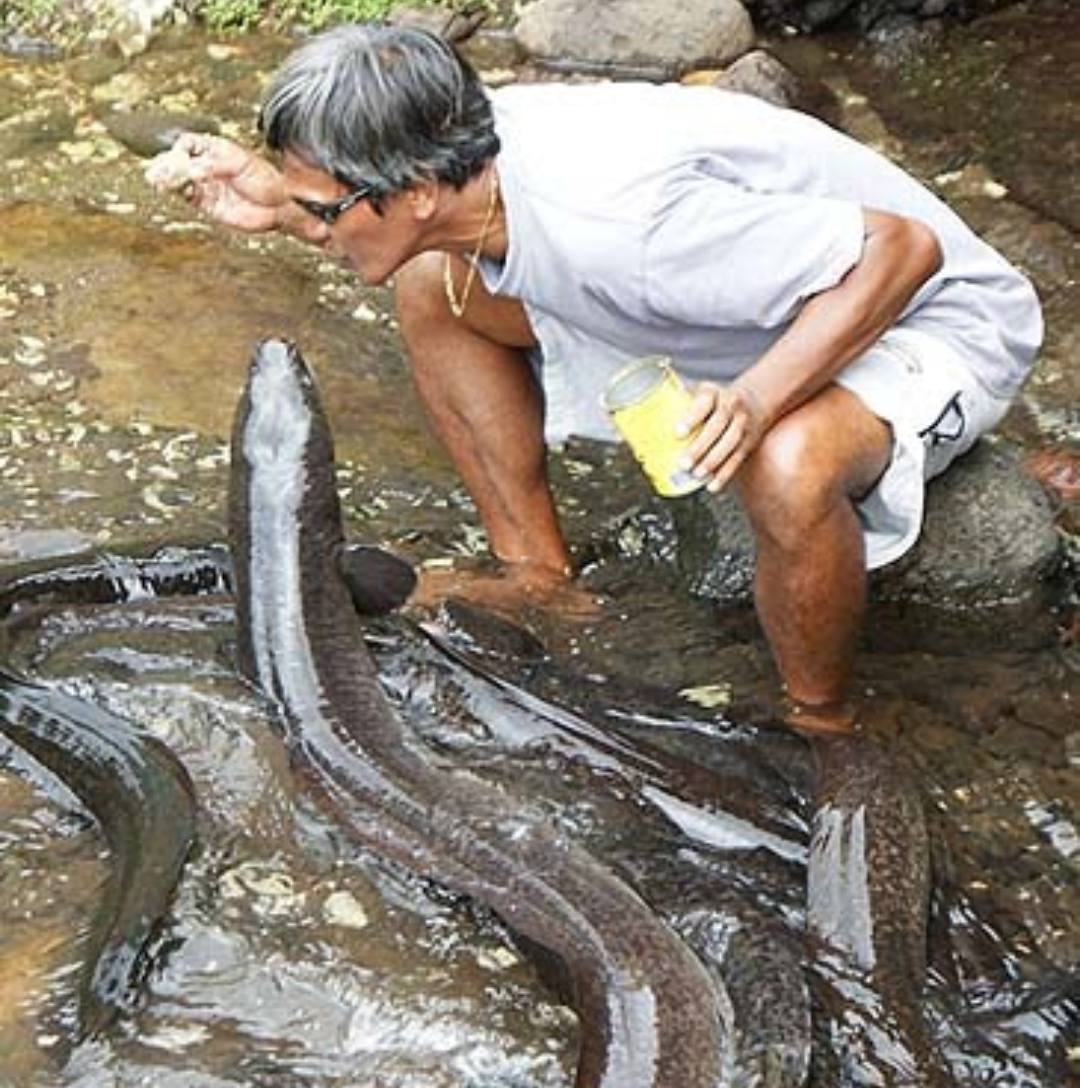
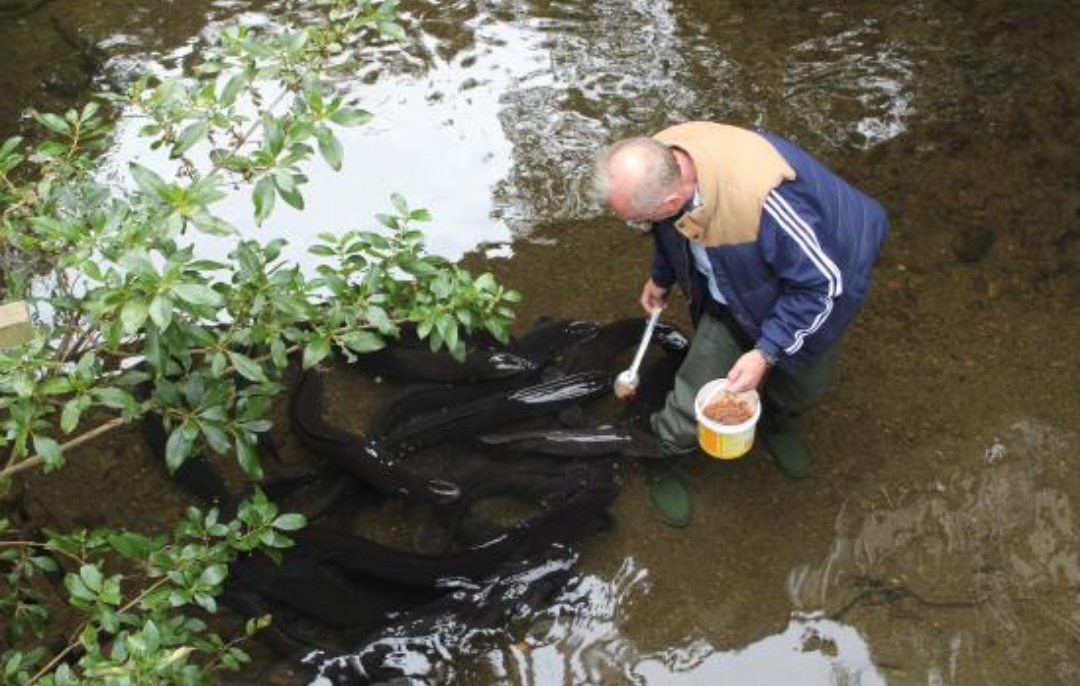
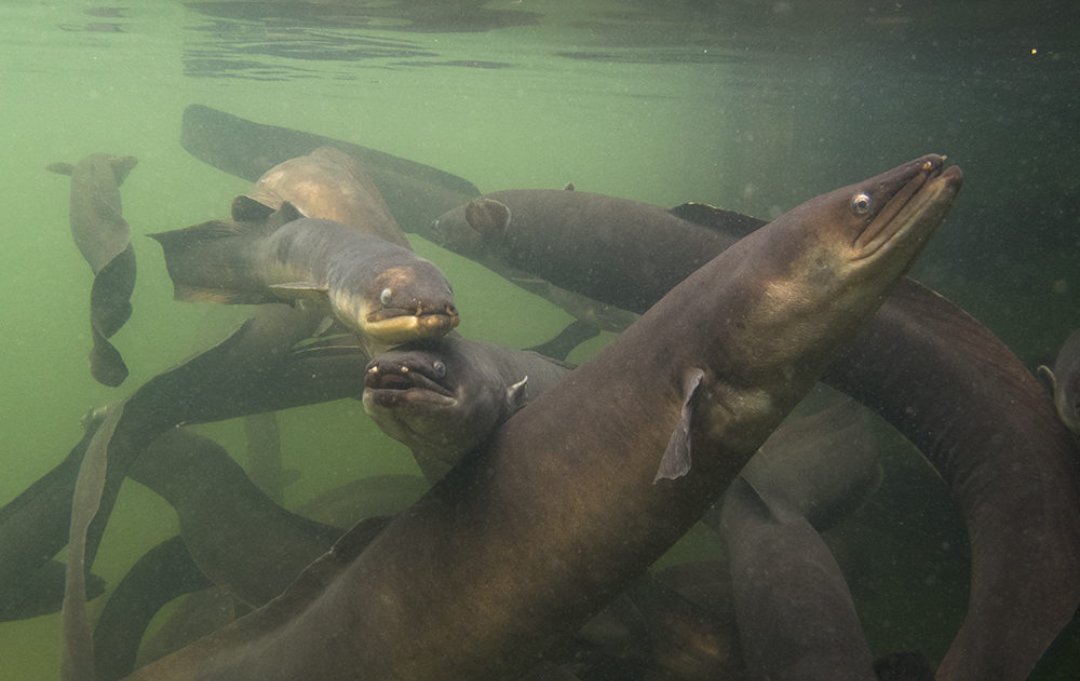
these wiggly fellas are Anguilla dieffenbachii, orNew Zealandlongfin eels. the ones in local rivers and preserves are known for being gentle, food-driven little weenies that beg tourists for food.
especially hungry wild specimens have been reported to attack humans and animals by swarming them and ripping off their flesh, but these ones are harmless!
@eelpatrickharris how can you tell them from other freshwater eels, I’m curious? I was looking around, and it seemed like while some are pretty different (some have spots, etc), there were a bunch that looked basically like this. I was thinking American eels, since OPs profile says Texas, but I certainly couldn’t tell for sure.
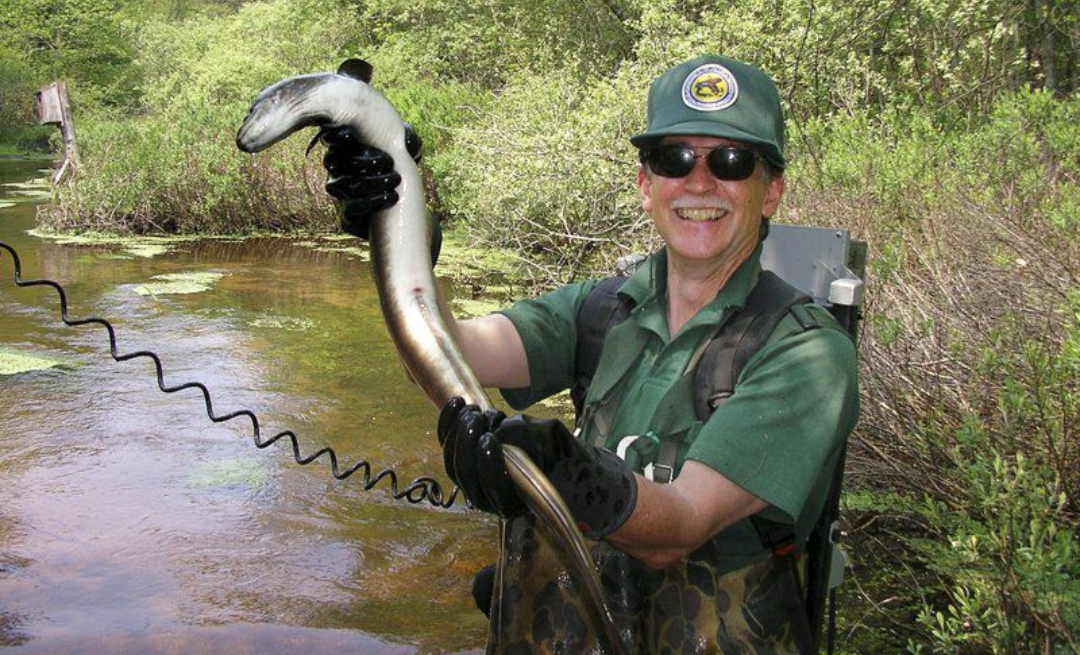
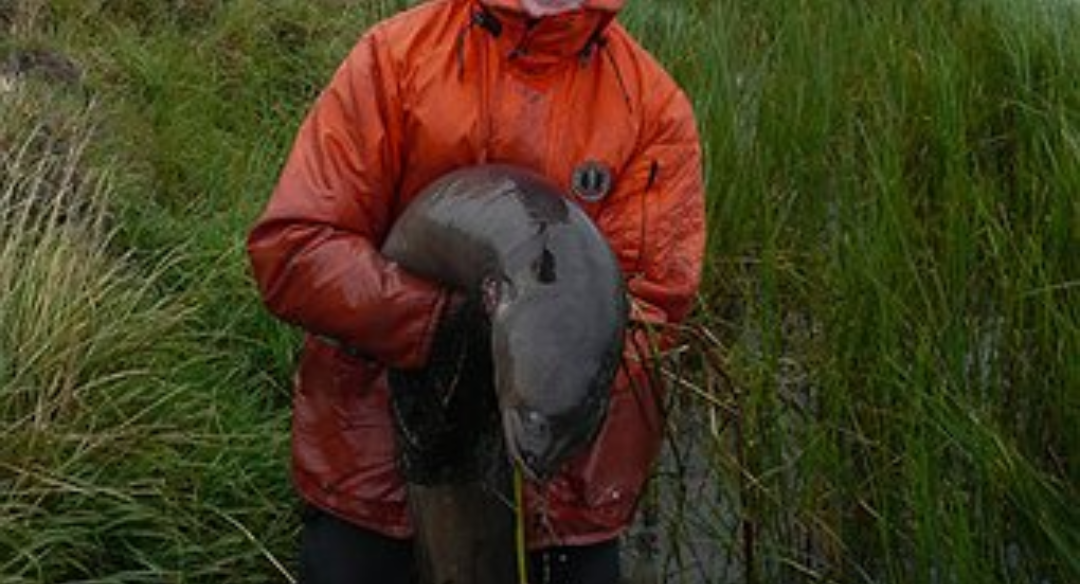
the size, behavior, and thickness! you see, NZ longfins are known for travelling in herds, and they are big boys. while the majority of anguilla eels grow to 3.3 feet on average—a. rostrata, a. anguilla, a. japonica—longfins can and will grow to 6 feet and over. there have been reports of them growing to 10 feet, but due to overfishing, any specimens like that are long gone.
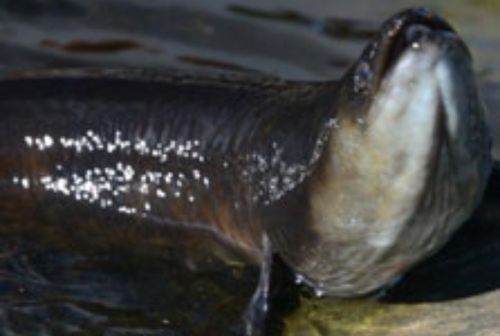
also, girth. top is a fully grown american eel (4 feet is their absolute maximum, 3 is average), and below is a new zealand longfin who has a few feet to go.
when it comes to mannerisms, you’ll almost never see american eels in groups outside of mating season, when they all migrate to the sea. they’re highly aggressive, distrustful of humans, and bitey. longfins, on the other hand, stick together and act like big water dogs.
it’s a common thing in NZ to have “pet” eels. people will feed scraps of meat to the ones in their local streams, and they’ll start wiggling excitedly when they see you! those eels in the video are just getting really pumped because they think someone has treats. (even though it’s bread, which is bad for them.)
they’re not as scary as they seem. NZ longfin eels just want to be your friend!
(note: this only applies to ones that live in preserves and rivers near civilization. eels from huge lakes and remote areas are generally starving and i don’t recommend trying to be their friend.)
Why is it called a Barreleye? Because it has barrels for eyes, of course! Actually, that’s just half the story…
Each eye is divided into two distinct parts. The larger, barrel section faces upward and is great for discerning the silhouettes of tiny, tasty copepods in the gloom above.
Next to those is the diverticular eye. These face downward and capture light using mirrors instead of lenses. This is particularly useful for gathering light, allowing the Spookfish to spot bioluminescent predators lurking below.
It doesn’t matter how flabby their muscles or gelatinous their flesh, no-ones sneaking up on the Brownsnout Spookfish!
Gonatodes is a genus of dwarf geckos that include many different species. Almost every species has a dramatic and unique color variation (in the males mostly). They mostly live in the forests of South America although some have adapted to live in cities and have been taken as pets.
They eat almost any bug that they can swallow. Some species of Gonatodes are becoming critically endangered due to deforestation.
Most of the species have pointed noses and are rather narrow in body size. However Gonatodes Daudini, shown here is the only one with large scales, bright orange irises and the 3 eye shaped patterns displayed by the males.
Today we learned that conches, the sea-dwelling mollusks who live inside those big, beautiful conch seashells in warm tropical waters, peer out at the world with cartoonish eyes on tiny eyestalks. They see you. They see everything. And what’s more, they can regenerate their peepers should they happen to lose one or both of them.
“One 1976 paper dug into the specific behind these animals’ alien eyestalks. Sitting at the tips of long stalks, they contain retinas with both sensory cells and colored pigment cells. But the story gets weirder because obviously, it gets weirder. After amputating the conchs’ eyes, a fully-formed replacement took its place 14 days later. Humans, we really are losing this evolutionary game.”
But wait, that’s hardly the only surprising set of eyes under the sea. Scallops have eyes too, LOTS of them:
This is rickety, wobbly-kneed beast is the scourge of east Australia’s sea slugs.
The sea slugs try to defend themselves. They eat corals, sponges and bryozoans, they take over the poisons and stinging cells, incorporating them into their tissues for use against their own predators.
But it doesn’t work. Not against Evan’s Sea Spider. It may only be a couple centimetres long, but this sea spider has guts of steel. And, of course, it’s a sea spider so its body is so tiny that half of those guts are in its legs.
Also there’s a whole lot of blue on those legs! They’re very important legs.
That is a Maned wolf and they are lovely bizarre creatures! They have long legs so they can see over the tall grass they live in, and tend to be very shy around humans (these are probably captive-born). Have some more pictures:
Walk Walk Fashion Baby
Here’s a baby!
Poofy!
Maned wolves are gorgeous. They’re also fascinating, because they’re not wolves and they’re not very closely related to any other species of canid – they’re actually in a totally separate genus, Chrysocyon.
They’re also nicknamed “skunk wolf” according to wikipedia, because of their odorous territorial markings, which is a distinct sort of stank I can personally confirm makes the appellation well earned.
As someone who has seen these in real life they are super cool and mildly unsettling. They kinda remind me of Remus’ when he turns into a wolf?
they look like a hyena on stilts im fascinated and afraid
It would look as a scientific illustration, but this pastel tone is how actually looks.
This soft nose is so rare it does not even have a full scientific name yet! Placed in the genus Bathyraja, this unusual looking deep sea dweller is known as the blond skate due to its unusual and unique coloration. Almost albino like, it is white to pink and even appears transparent in parts. No other skates in the New Zealand region, except Bathyraja shuntovi, have this colouration.
This skate is known from just five specimens from deep water across a very wide latitudinal range. These five specimens have been examined by the Fish team at Museum of New Zealand Te Papa Tongarewa. The largest skate was a mature male at 1.25 m from the tip of nose to the end of the tail. They have been found in water between 1200 m and 1700 m deep from Northland to the sub-Antarctic. We


 lovingdread