Science Fact Friday: Bird lungs! Just like every other part of a bird, they’re weird.
This gif shows the path of a single breath, but the circuit holds 2 breaths at a time. So when the bird inhales, the just-inhaled breath goes through Inhalation 1 while the previous breath goes through Inhalation 2. Rinse, repeat. Thus, the lungs are constantly receiving oxygen – in mammals, our oxygen content dips slightly between inhalations because there’s no fresh air coming in. We also don’t empty 100% of our lung volume so some air is “stale” even during an inhalation.
‘While they were taking the [micro-CT] scan, they found that the dodo’s skull
was covered with lead shot pellets. The bird, they realized, had been
blasted from behind (though notably, the pellets were not able to
penetrate its thick skull).
The Museum of Natural History believed it knew the provenance of the Oxford dodo. Several live dodos were reportedly
brought to Europe in the 1600s (many of them subsequently suffered from
obesity, skewing our image of the dodo, but that’s another story). One
of these dodos supposedly lived in London and is mentioned in a 1638 anecdote. After its death, the creature was taxidermied and then acquired by a London museum…’
‘The shot to the head raises the question
whether the Oxford dodo comes from the purported living dodo, or if it
was one hunted in the wild. “There is now a mystery regarding how the
specimen came to be in Tradescant’s collection,” Paul Smith, the
director of the Oxford University Museum of Natural History, tells
Geggel.
It also begs the question: who killed the bird? In an interview with Nicola Davis at The Guardian, Smith says there’s no simple answer. “If
it was the bird that was in London in 1638, why would anyone just shoot
a dodo in London,” he says. “And if it was [shot] in Mauritius, which
is I suppose marginally more likely, there is a really serious question
about how it was preserved and transported back, because they didn’t
have many of the techniques that we use in the modern-day to preserve
soft tissues – and we know it came back with its feathers and its skin
intact.”’
This is a really interesting finding. A few other possibilities occurred to me:
1.
The animal survived being shot, and was captured at a later date 2. The animal was next to a conspecific when the latter was shot 3.
The animal became ill while in captivity, and was euthanized with a shot to the head
A special eye protein is helping birds to “see” Earth’s magnetic field! If that’s not cool, I don’t know what is.
The ability to see Earth’s magnetic field, known as magnetoreception, relies on the presence of specifically the blue wavelength of light. The complex process involves “radical” intermediate molecules which are sensitive to Earth’s magnetic field. The Earth’s magnetic field, as it relates to the direction the bird is facing, could alter the intermediate radical molecules differently, giving the bird a sense for where it is facing in relation to the Earth’s magnetic field.
While the exact way birds visualize Earth’s magnetic field is part of further investigation, scientists believe the Cry4 protein acts as sort of a filter over the bird’s vision. This filter would allow birds to see a sort of compass of the Earth and direct their migratory flights accordingly.
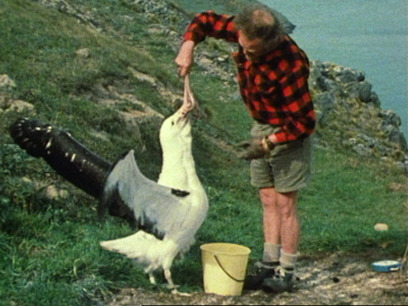
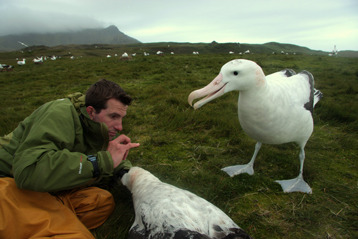
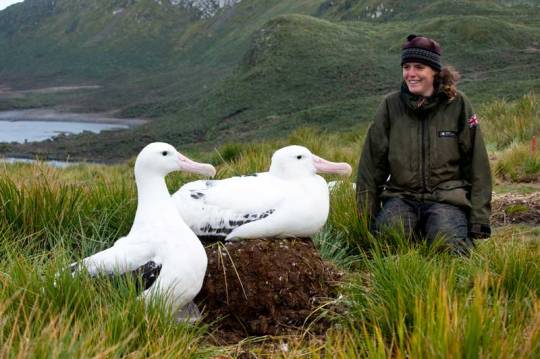
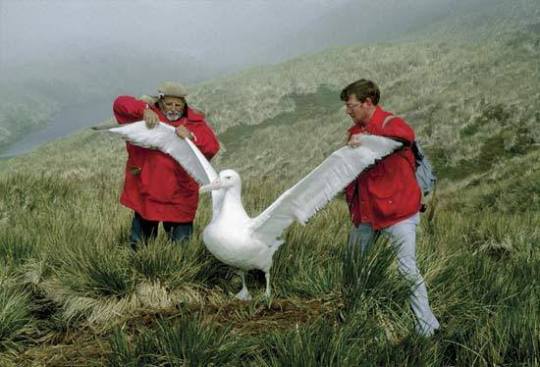
hey did you know how big an albatross was because I
VERY
fucking
did not
i’m so glad people are learning this.
I… I knew in numerical values how big they were, but I’ve never seen them next to humans before
A LORGE BIRB
I thought albatross was another word for “seagull” not for “terror of the fucking sky”
The reason albatross are so huge is because they need huge wings for their unique lifestyle.
Albatross can go months, if not over a year without seeing land.There is a pocket of air trapped between wave fronts and they just ride ontop of it. To make that work, they need huge wings. If the winds die they rest on the surface, and wait for the winds to return; the huge wings mean it’s not worth it to fly any other way. When they need to eat they pluck fish and squid from the surface, and sometimes dive. Nobody is entirely sure if they sleep on the wing, and if so, how.
The large wings also mean that taking off and landing are the hardest parts of flying for an albatross. Generally they avoid it, but for nesting and resting, it’s unavoidable.
Albatross have complex mating dances, and selecting a mate can take years; as they narrow down partners they create their own dancing language that they invent themselves. Once half of a pair has died, that dance is lost. These couples do not travel together once their chick has grown (and it is always a single chick at a time). Instead they will separate to travel the world, not seeing each other again until it is time to return to the island they themselves hatched from, as have hundreds of generations before them. Wanderers, who always find their way home.
One of my favorite chicken facts to share is that hens can “become” roosters, at least in regards to their appearance and some behaviors. Long story short, hens have one working ovary; if it ceases to function, they can become more male-like (read more about it here). But since it’s a fairly rare phenomenon, I didn’t think it would happen to one of my own chickens!
Meet Coco. Several months ago, she had fallen under the weather only to reemerge with redder, shinier feathers and a longer, arched tail. Coincidentally, the males of her breed are mostly red, and that tail sure is getting rooster-y. My best guess is that Coco has been undergoing a spontaneous sex reversal.
Coco seems to enjoy this transformation, especially since she doesn’t have to worry about laying eggs anymore. You go, new Coco!





 lovingdread